Comparison with llama.cpp
This page compares Krafla and llama.cpp running the same model, with the same weight formats, on one machine at four x86 instruction-set levels. The GitHub runners section repeats the comparison on an x86-64 machine without AVX-512 and at three levels on AArch64. scripts/compare_llamacpp.sh reproduces each run.
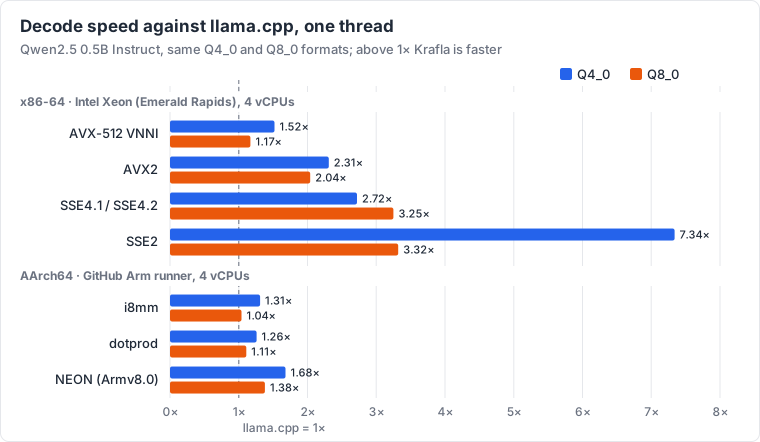
The chart shows the one-thread decode ratios of the tables below (scripts/sync_docs.py draws it from them).
Setup
- Machine: 4 vCPUs of an Intel Xeon at 2.10 GHz (Emerald Rapids) with AVX-512 VNNI and AMX, 15 GB of RAM; GCC 13.3 for both runtimes. llama.cpp’s native build uses AMX tiles for prefill on this CPU (see below); Krafla has no AMX kernels.
-
llama.cpp: release b11835 (commit
f64a498), CPU backend, built four times:Build Options AVX-512 VNNI GGML_NATIVE=ONAVX2 GGML_NATIVE=OFF, AVX, AVX2, BMI2, FMA, F16C; no AVX-512SSE4.2 GGML_NATIVE=OFF, SSE4.2 onlySSE2 GGML_NATIVE=OFF, every x86 extension offKrafla builds for
avx512vnni,avx2,sse41andsse2, withTHREADS=pthread. The SSE4.2 llama.cpp build is compared with Krafla’s SSE4.1 build, because SSE4.2 adds only string and CRC instructions. - Model: Qwen2.5 0.5B Instruct. llama.cpp quantizes the official
qwen2.5-0.5b-instruct-fp16.ggufwithllama-quantize --pure, so that every matrix, embeddings and classifier included, is Q8_0 or Q4_0, as in Krafla’s--wtype q8and--wtype q4files. Krafla’s files have f16 scales and take 500 MiB (Q8_0) and 265 MiB (Q4_0), against 644 and 343 MiB for llama.cpp’s, so they are 22–23% smaller. Qwen2.5 0.5B ties its classifier to the embedding, and the GGUF files store it a second time; each runtime reads one copy per token. - Speed: prefill of 128 tokens, then 128 tokens decoded after them (
ml_bench -n 128;llama-bench -p 128 -n 0and-p 0 -n 128 -d 128), mean of 3 runs, tokens per second. - Quality: wikitext-2 test set, 4 chunks of 512 tokens, the second half of each chunk scored:
llama-perplexity -c 512 --chunks 4andtools/perplexity.py --llama-cpp, which chunks and scores the same way.
Speed
Speeds are in tokens per second. The decode ratio is Krafla’s decode speed divided by llama.cpp’s.
| ISA level | Weights | Threads | Krafla prefill | llama.cpp prefill | Krafla decode | llama.cpp decode | Decode ratio |
|---|---|---|---|---|---|---|---|
| AVX-512 VNNI | Q8_0 | 1 | 318.5 | 368.5 | 24.0 | 20.5 | 1.17× |
| AVX-512 VNNI | Q8_0 | 4 | 870.8 | 935.1 | 72.8 | 60.7 | 1.20× |
| AVX-512 VNNI | Q4_0 | 1 | 331.4 | 339.8 | 44.0 | 29.0 | 1.52× |
| AVX-512 VNNI | Q4_0 | 4 | 1118.9 | 1303.9 | 133.4 | 95.7 | 1.39× |
| AVX2 | Q8_0 | 1 | 95.9 | 70.6 | 22.4 | 11.0 | 2.04× |
| AVX2 | Q8_0 | 4 | 265.2 | 189.5 | 72.4 | 38.2 | 1.90× |
| AVX2 | Q4_0 | 1 | 182.6 | 82.7 | 41.6 | 18.0 | 2.31× |
| AVX2 | Q4_0 | 4 | 541.9 | 309.8 | 128.6 | 60.6 | 2.12× |
| SSE4.1 / SSE4.2 | Q8_0 | 1 | 47.7 | 13.9 | 20.5 | 6.3 | 3.25× |
| SSE4.1 / SSE4.2 | Q8_0 | 4 | 161.0 | 57.8 | 59.4 | 22.7 | 2.62× |
| SSE4.1 / SSE4.2 | Q4_0 | 1 | 64.9 | 26.9 | 33.4 | 12.3 | 2.72× |
| SSE4.1 / SSE4.2 | Q4_0 | 4 | 226.0 | 111.5 | 90.2 | 42.1 | 2.14× |
| SSE2 | Q8_0 | 1 | 39.6 | 12.8 | 20.6 | 6.2 | 3.32× |
| SSE2 | Q8_0 | 4 | 126.0 | 49.8 | 56.4 | 21.2 | 2.66× |
| SSE2 | Q4_0 | 1 | 36.7 | 5.7 | 25.7 | 3.5 | 7.34× |
| SSE2 | Q4_0 | 4 | 124.4 | 21.8 | 77.3 | 12.7 | 6.09× |
Measured with Krafla at commit 1c6db5a (the 0.4.0 code). Against the previous run (0cb4d16), AVX-512 VNNI prefill went from 221 to 319 tok/s (Q8_0, 1 thread) and from 890 to 1119 (Q4_0, 4 threads), and decode from 41.6 to 44.0 (Q4_0, 1 thread). Before 0.4.0, when Krafla’s prefill ran in steps of 32 tokens instead of 128, llama.cpp’s Q8_0 prefill with AVX-512 VNNI led by 1.6–1.8×. Before 0.4.0’s signed-nibble kernels, llama.cpp’s dotprod Q4_0 prefill on the Arm runner led by 1.34–1.37×. llama.cpp’s own numbers move by a few percent between runs on the same kind of machine, so compare rows of one run.
- Decode with Krafla is at least as fast as with llama.cpp at every ISA level measured: 1.2–1.5× as fast with AVX-512 VNNI, 1.9–2.3× with AVX2, and 2.1–7.3× on the SSE builds.
- Prefill with AVX-512 VNNI is faster with the native llama.cpp build: by 1.07–1.16× for Q8_0 and by up to 1.17× for Q4_0. From AVX2 down, Krafla prefills faster (1.4–6.4×).
The native llama.cpp build gets its prefill speed from AMX, not from AVX-512 VNNI: by default it repacks its weights for AMX tiles. With repacking turned off (llama-bench --repack 0, on the same machine in a later run), it prefills Q8_0 at 93 tok/s on one thread and 318 tok/s on four, and Q4_0 at 83 and 320 tok/s. That is about a third of Krafla’s speed in the AVX-512 VNNI rows.
An AMX kernel for Krafla’s packed layout is kept on the exp/amx branch and is not part of the build. Each 32-weight block has its own scale, so the kernel has to store each 16×16 tile product and rescale it with AVX-512, in the same order as the matrix-vector kernel; this keeps prefill bit-identical to decoding. Microbenchmarks on this CPU show where the time goes. They run on one core with the weights in L2, and the times are per block of 16 tokens × 16 rows:
| Work per block | ns |
|---|---|
tile loads and tdpbsud alone | 10.9 |
| the same plus zeroing and storing the sum tile | 16.4 |
| rescaling alone (convert, multiply, FMA per token) | 12.8 |
the same with the offset * sum(x) subtraction | 17.9 |
| tiles and rescaling together | 34–37 |
The tile instructions and the AVX-512 rescaling do not overlap: their times add up. The second version of the kernel removes the subtraction, as the microbenchmark suggested: Q8 sum tiles start at -128 * sum(x), loaded from a buffer built once per tile of tokens, and Q4 nibbles are widened to q - 8 for tdpbssd. On the kernels alone, Q8_0 got 5–13% faster than the first version (1.2–1.4× as fast as the AVX-512 VNNI kernel) and Q4_0 20–43% faster (1.0–1.2× as fast).
On Qwen2.5 0.5B, prefill with this kernel is level with the AVX-512 VNNI build on one thread and 15–20% slower on four threads, so AMX stays out of the build.
GitHub runners
The llama.cpp comparison workflow (.github/workflows/compare.yml, started by hand) builds both runtimes and runs scripts/compare_llamacpp.sh on two GitHub runners: ubuntu-24.04 (x86-64, 4 vCPUs with AVX2 but no AVX-512) and ubuntu-24.04-arm (AArch64, 4 vCPUs with dotprod and i8mm). On AArch64 the llama.cpp builds are the native one (against Krafla’s best build, neon_i8mm), armv8.2-a+dotprod and armv8-a. The tables below come from one run, with Krafla 1c6db5a (the 0.4.0 code) and llama.cpp b11835.
x86-64 (AVX2)
| ISA level | Weights | Threads | Krafla prefill | llama.cpp prefill | Krafla decode | llama.cpp decode | Decode ratio |
|---|---|---|---|---|---|---|---|
| AVX2 | Q8_0 | 1 | 133.4 | 94.4 | 38.8 | 29.7 | 1.31× |
| AVX2 | Q8_0 | 4 | 261.3 | 180.1 | 62.5 | 61.0 | 1.02× |
| AVX2 | Q4_0 | 1 | 216.3 | 114.7 | 75.9 | 43.1 | 1.76× |
| AVX2 | Q4_0 | 4 | 435.1 | 238.8 | 109.4 | 85.4 | 1.28× |
| SSE4.1 / SSE4.2 | Q8_0 | 1 | 60.8 | 16.7 | 34.2 | 9.6 | 3.56× |
| SSE4.1 / SSE4.2 | Q8_0 | 4 | 120.4 | 34.9 | 58.7 | 19.6 | 2.99× |
| SSE4.1 / SSE4.2 | Q4_0 | 1 | 90.2 | 32.0 | 40.8 | 15.9 | 2.57× |
| SSE4.1 / SSE4.2 | Q4_0 | 4 | 182.1 | 66.8 | 78.7 | 32.0 | 2.46× |
| SSE2 | Q8_0 | 1 | 47.4 | 16.1 | 26.8 | 9.2 | 2.91× |
| SSE2 | Q8_0 | 4 | 94.9 | 34.3 | 50.1 | 19.8 | 2.53× |
| SSE2 | Q4_0 | 1 | 49.7 | 5.1 | 33.5 | 3.3 | 10.15× |
| SSE2 | Q4_0 | 4 | 101.3 | 10.2 | 64.7 | 6.7 | 9.66× |
AArch64
| ISA level | Weights | Threads | Krafla prefill | llama.cpp prefill | Krafla decode | llama.cpp decode | Decode ratio |
|---|---|---|---|---|---|---|---|
| i8mm (native) | Q8_0 | 1 | 183.0 | 127.4 | 35.6 | 34.2 | 1.04× |
| i8mm (native) | Q8_0 | 4 | 714.6 | 430.8 | 110.1 | 104.0 | 1.06× |
| i8mm (native) | Q4_0 | 1 | 173.1 | 148.3 | 50.8 | 38.7 | 1.31× |
| i8mm (native) | Q4_0 | 4 | 682.5 | 484.0 | 143.2 | 114.6 | 1.25× |
| dotprod | Q8_0 | 1 | 148.3 | 129.7 | 35.7 | 32.1 | 1.11× |
| dotprod | Q8_0 | 4 | 570.5 | 496.6 | 107.3 | 100.7 | 1.07× |
| dotprod | Q4_0 | 1 | 138.1 | 156.6 | 50.8 | 40.2 | 1.26× |
| dotprod | Q4_0 | 4 | 535.0 | 590.8 | 143.2 | 118.9 | 1.20× |
| NEON (Armv8.0) | Q8_0 | 1 | 36.5 | 26.7 | 21.7 | 15.7 | 1.38× |
| NEON (Armv8.0) | Q8_0 | 4 | 142.7 | 105.7 | 66.8 | 50.7 | 1.32× |
| NEON (Armv8.0) | Q4_0 | 1 | 41.1 | 24.3 | 26.5 | 15.8 | 1.68× |
| NEON (Armv8.0) | Q4_0 | 4 | 160.8 | 96.1 | 81.2 | 53.3 | 1.52× |
On x86-64 without AVX-512, Krafla is at least as fast as llama.cpp at every ISA level measured. It decodes 1.0–1.8× as fast with AVX2 and 2.5–10× as fast on the SSE builds, and it prefills 1.4–1.9× as fast with AVX2 and 2.7–10× as fast on the SSE builds.
On AArch64 with dotprod and i8mm, Krafla decodes 1.04–1.11× as fast as llama.cpp for Q8_0 and 1.20–1.31× as fast for Q4_0. With plain ARMv8.0 NEON, it is 1.3–1.7× as fast in both prefill and decode. With i8mm it prefills 1.4–1.7× as fast for Q8_0 and 1.2–1.4× as fast for Q4_0, and with dotprod 1.14× as fast for Q8_0. Only dotprod Q4_0 prefill is faster with llama.cpp, by 1.10–1.13×, because of llama.cpp’s repacked Q4_0 kernels.
Quality
| Runtime | Weights | Perplexity |
|---|---|---|
| llama.cpp | F16 | 13.34 |
| llama.cpp | Q8_0 | 13.44 |
| Krafla | Q8_0 | 13.32 |
| llama.cpp | Q4_0 | 15.86 |
| Krafla | Q4_0 | 15.14 |
The results are about the same on all three machines: Krafla’s Q8_0 scores 13.32–13.35 against 13.34 for llama.cpp’s F16, and its Q4_0 scores 15.09–15.14 against 15.82–15.93 for llama.cpp’s Q4_0.
The two runtimes tokenize this text identically (no BOS for Qwen2.5). Krafla’s Q8_0 matches F16. Its Q4_0 is closer to F16 than llama.cpp’s (15.14 against 15.86) because tools/convert.py fits each block’s scale (see Q8, Q4, or mixed?), while llama-quantize without an importance matrix maps the largest weight to -8. llama.cpp’s default Q4_0 (without --pure) keeps the classifier in a higher-precision type, which Krafla can do with --q8 cls. Neither row uses an importance matrix; with one collected on the wikitext-2 training set, Krafla’s Q4_0 scores 14.52 (importance matrix).
Qwen3.5 0.8B (linear attention)
Qwen3.5 0.8B, on the AVX-512 VNNI machine with 4 threads, against ggml-org’s GGUF files of the same model and llama.cpp from October 2026. Perplexity on the first 4 chunks of 512 tokens of wikitext-2 (tools/perplexity.py --llama-cpp), speed from ml_bench -n 128 and llama-bench -p 128 -n 128:
| Runtime | Weights | Size | Perplexity | Prefill | Decode |
|---|---|---|---|---|---|
| llama.cpp | BF16 | 1486 MiB | 15.74 | ||
| llama.cpp | Q8_0 | 795 MiB | 15.79 | 304 tok/s | 39.0 tok/s |
| Krafla | Q8_0 | 764 MiB | 15.80 | 471 tok/s | 49.8 tok/s |
| llama.cpp | Q4_0 | 537 MiB | 18.95 | 275 tok/s | 47.3 tok/s |
| Krafla | Q4_0 | 406 MiB | 18.41 | 541 tok/s | 80.0 tok/s |
| Krafla | Q4_0, v,o,down in Q8_0 | 491 MiB | 16.63 |
Qwen3.5 4B, whose value heads share key heads two by two, against unsloth’s Q8_0 GGUF (64 prompt and 64 decoded tokens):
| Runtime | Weights | Perplexity | Prefill | Decode |
|---|---|---|---|---|
| llama.cpp | Q8_0 | 8.15 | 58 tok/s | 9.0 tok/s |
| Krafla | Q8_0 | 8.18 | 100 tok/s | 9.8 tok/s |
Reproducing
git clone --depth 1 --branch b11835 https://github.com/ggml-org/llama.cpp
cd llama.cpp
cmake -S . -B build-native -DCMAKE_BUILD_TYPE=Release -DGGML_NATIVE=ON
cmake --build build-native -j --target llama-bench llama-perplexity llama-quantize
# build-avx2, build-sse42, build-base: -DGGML_NATIVE=OFF with the options above
cd -
scripts/compare_llamacpp.sh ../llama.cpp ./Qwen2.5-0.5B-Instruct \
    qwen2.5-0.5b-instruct-fp16.gguf wikitext-2-test.txt build/compare
The script converts the model for Krafla, quantizes the GGUF, runs both benchmarks and writes build/compare/results.md. It picks the ISA levels from the host: on AArch64 the llama.cpp build directories are build-native, build-dotprod (-DGGML_NATIVE=OFF -DGGML_CPU_ARM_ARCH=armv8.2-a+dotprod) and build-base (armv8-a). A missing llama.cpp build directory skips that row; THREADS, TOKENS, REPS, CTX and CHUNKS change the settings.
On GitHub, run the llama.cpp comparison workflow (Actions tab, Run workflow); it reports each machine’s table in the run summary, as an artifact and as an annotation.