contilab
A PyTorch framework for continual learning research: benchmark methods against catastrophic forgetting, and compare them with model merging and distillation, on vision and language models.
Get started See the results GitHub
contilab trains a model on a sequence of tasks and measures what it forgets. This setting is called continual learning, and also lifelong or incremental learning. contilab is built for empirical studies: fair, reproducible comparisons of methods across seeds, benchmarks and model sizes.
- 12 methods, one evaluation.
- Sequential methods: Naive fine-tuning, Joint training, EWC, LwF, Experience Replay, DER++, A-GEM and LoRA-per-task.
- Train-then-consolidate pipelines: Task Arithmetic, TIES-Merging, multi-teacher distillation and teacher → student continual distillation.
- Every method is scored with the same metrics.
- 30+ metrics, computed after training. Forgetting, backward and forward transfer, the stability gap, linear-probe and CKA representation metrics, plasticity loss, task-recency bias, calibration, few-shot recovery and LLM general-ability retention. Raw data are stored, so a new metric needs no retraining.
- Statistics included.
- Mean ± std and bootstrap confidence intervals over seeds
- Exact paired tests, and Friedman and Nemenyi critical-difference diagrams across benchmarks
- Hyperparameter sweeps resolved on validation accuracy
- Fast on a CPU. Several seeds train at once as one
vmapensemble: 3.8× the throughput for an MLP (Performance). - Vision and language. Split MNIST, Permuted MNIST, Split CIFAR-10/100, and text5 with Hugging Face language models such as Pythia and Qwen2.5.
Results at a glance
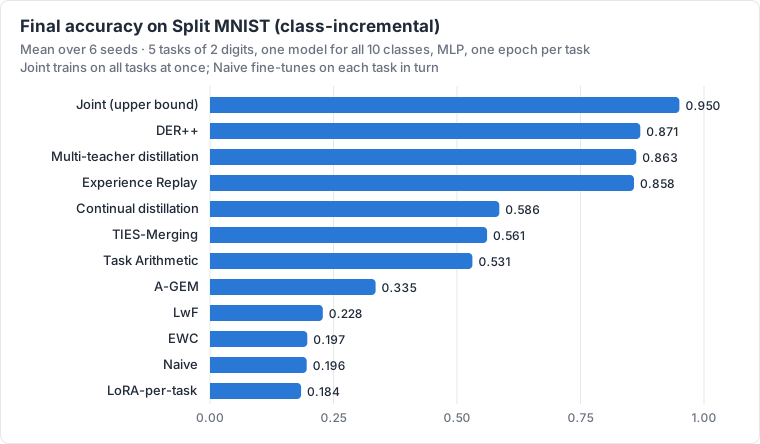
A CPU study ran 12 methods on 6 benchmarks: 324 runs, with 3 to 6 seeds each.
- Replay leads. After Joint training, DER++ and Experience Replay have the best average ranks across the 6 benchmarks: 2.7 and 4.2 (Friedman p = 6.6·10⁻⁶).
- Multi-teacher distillation needed tuning. Settings chosen on validation accuracy lifted it from 0.223 to 0.871 on Split MNIST (class-incremental). With them as defaults it reaches 0.863 over 6 seeds, not significantly different from DER++ (0.871).
- Regularisation alone stays at the Naive level in class-incremental learning, even after tuning: EWC 0.197 and LwF 0.228 against 0.196.
- Continual distillation stores no experts. Its 2×100 student keeps 98 % of the full-size accuracy on Permuted MNIST in 0.34 MB.
Every number, the tuned comparison and the per-run CSV files are on the Results page.
Quick start
git clone https://github.com/JonPark0/contilab && cd contilab
python3 -m venv .venv && .venv/bin/pip install -e '.[dev]'

# every method on tiny synthetic streams (under a minute on 4 CPU cores)
.venv/bin/contilab run configs/experiments/smoke_all.yaml
.venv/bin/contilab report runs/smoke_all          # runs/smoke_all/report.md and report.html

# one real benchmark: Split MNIST, class-incremental, all 12 methods
.venv/bin/contilab run configs/experiments/cpu_main.yaml "matrix.preset=[split_mnist_class]"
Or install a release wheel with pip. The Getting started page walks through a first run and the report; the FAQ answers the common questions.
What is included
| Area | Contents |
|---|---|
| Scenarios | Task-incremental, class-incremental, domain-incremental |
| Methods | Naive, Joint, EWC (online), LwF, Experience Replay, DER++, A-GEM, LoRA-per-task |
| Merging and distillation | Task Arithmetic, TIES-Merging, multi-teacher distillation, teacher → student continual distillation, smaller students |
| Benchmarks | Split MNIST, Permuted MNIST, Split CIFAR-10, Split CIFAR-100, text5 (AG News → Yelp → Amazon → DBpedia → Yahoo Answers) |
| Metrics | 30+ metrics, figures (accuracy heatmaps, stability-gap curves, CKA, t-SNE, loss barriers, critical-difference diagrams) |
| Engineering | vmap seed ensembles, torch.compile, bf16, resumable experiment matrices, failure isolation, Markdown and HTML reports |
Citing
@software{contilab2026,
  author  = {Park, Yeochoon},
  title   = {contilab: a performance-first framework for continual learning benchmarking, distillation and model merging},
  year    = {2026},
  version = {0.3.1},
  doi     = {10.5281/zenodo.23906803},
  url     = {https://github.com/JonPark0/contilab}
}
Every release is archived on Zenodo. The DOI 10.5281/zenodo.23906803 stands for all versions and resolves to the latest one; each release also has its own DOI, listed on the Zenodo page.
Source code: https://github.com/JonPark0/contilab · License: MIT